Last updated: June 2026
The road south from Marrakech climbs fast. Within ninety minutes you’re at 1,740 metres and the city heat is gone. Imlil is a real Berber village - not a tourist set piece - and the mountain above it, Jbel Toubkal at 4,167m, is North Africa’s highest peak. These two facts create two entirely different trips. One is a gentle day out that almost anyone can do; the other is a physical undertaking that requires preparation, a guide by law, and potentially specialist gear. Knowing which one you’re booking is important.
Getting to Imlil from Marrakech
Imlil sits roughly 65 kilometres south of Marrakech, and the drive takes around 90 minutes to two hours depending on traffic leaving the city and the road conditions above Asni.
You have three options for the journey:
Shared grand taxi is the budget choice. The rank near Bab Er Robb runs taxis to Asni, where you change for another taxi to Imlil. The total cost is around 30-50 MAD per person each way. The catch is that taxis fill before they leave - so you either share the cab with strangers or pay for the empty seats. If you’re travelling on a Saturday, the weekly souk in Asni adds a delay.
Private taxi or hire car costs around 300-600 MAD return and gives you control over timing. Worth it for an early start, especially if you’re planning the waterfall hike.
Organised day tour typically costs 300-600 MAD per person all in, including transport and a local guide. See our Atlas Mountains day trips guide for how to choose a reputable operator.
The road past Asni becomes a winding single carriageway with spectacular views across the Ait Mizane valley. If you’re prone to carsickness, take the front seat.
The Day Trip Version: Imlil, Armed Village, and the Waterfall
This is the version most visitors do, and it’s genuinely worthwhile. You don’t need to be particularly fit, and you don’t need any special equipment beyond comfortable walking shoes.
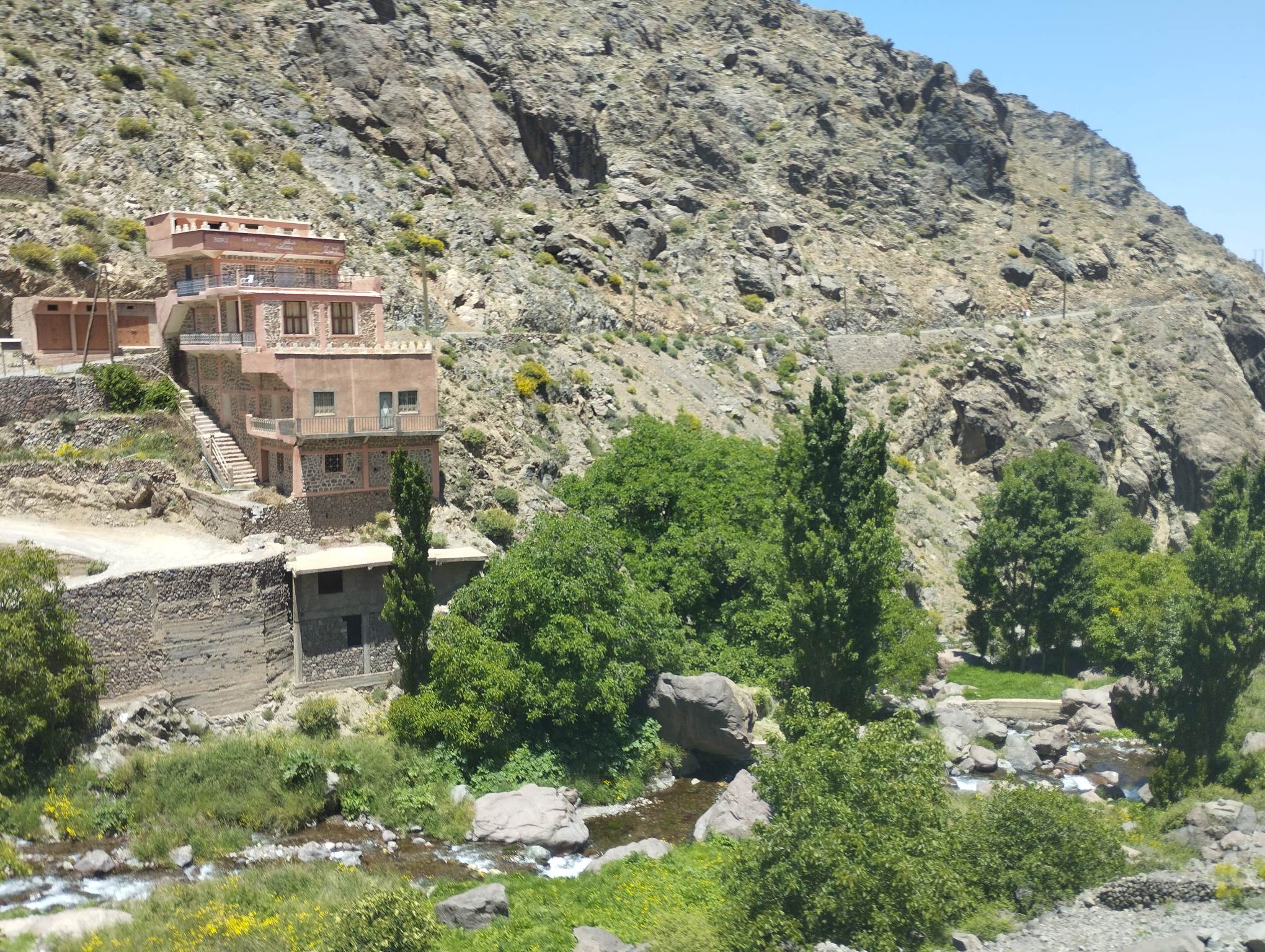
From Imlil village (1,740m), the most popular route takes you up through walnut and apple orchards to Armed (also written Armound), the largest traditional Berber village in the valley at around 1,960m. The walk up takes 45 minutes to an hour at a comfortable pace. The village sits on a rocky spur above the valley floor and the views back down are excellent.
The waterfall is a separate short detour - about a kilometre from Imlil on a flat path that runs along the valley bottom. The cascade itself is modest in summer but the walk through the trees and along the irrigation channels is pleasant.
A realistic day from Marrakech looks like this:
- 8:30am - Leave Marrakech
- 10:00-10:30am - Arrive Imlil, pick up a local guide if not pre-arranged
- 10:30am-12:30pm - Walk to Armed village, explore, take in the views
- 1:00pm - Berber lunch (tagine, bread, mint tea) at a village guesthouse or cafe. Budget 80-150 MAD per person
- 2:30pm - Walk to the waterfall or take the direct route back to Imlil
- 4:00pm - Head back to Marrakech
- 5:30-6:00pm - Back in Marrakech
The total walking time is around 3-4 hours, with modest elevation gain of around 250-300 metres. This is suitable for anyone with a reasonable level of fitness, including older travellers and older teenagers. The paths are stony rather than paved - ankle support is helpful but a serious boot is overkill in dry conditions.
For context on how this compares to other options out of the city, see our guide to the best day trips from Marrakech.
The Serious Version: Toubkal Summit Trek (4,167m)
If you’re thinking about actually climbing Toubkal, the frame shifts completely. This is not a day hike.
The standard itinerary is two days:
Day 1: Imlil to the Toubkal Refuge (also called the Neltner Hut), at around 3,207m. This takes 4-5 hours at a steady pace, climbing 1,500 metres through increasingly barren terrain. You overnight at the refuge.
Day 2: Early start (typically 5:00-6:00am) for the summit push. The ascent to 4,167m takes around 3-4 hours over loose scree and, in winter, snow and ice. Descent back to Imlil the same day, arriving mid-afternoon.
Guide Requirement - This is Not Optional
Since 2018, a licensed guide is mandatory for the Toubkal summit trek. This is enforced at police checkpoints on the route, where both your passport and your guide’s credentials are checked. There is no workaround. Attempting the route without a guide means you will be turned back.
A licensed local guide costs around €50-80 per day. Spread across a small group that works out to €25-40 per person per day. A full organised 2-day Toubkal trek with guide, transport, mule for baggage, and refuge accommodation typically costs €120-280 per person depending on group size and operator.
The Refuge
The Toubkal Refuge (Refuge du Toubkal / Neltner Hut) sits at 3,207m and is the standard overnight stop. There are two main options - the French-managed Refuge du Toubkal and the Gite Camping les Mouflons next to it. Both provide dormitory accommodation, basic meals, and limited washing facilities. Expect to pay around 175-200 MAD per person for a dorm bed; full board is available.
Advance booking is essential between April and October. The huts fill completely over Easter, throughout August, and during September - Morocco’s most popular trekking month. Book directly through refugedutoubkal.com or via your tour operator.
Winter Conditions: What Changes
Between December and April, the mountain above 2,500m carries snow and ice. This changes the trip from a strenuous hike to a proper winter mountaineering objective.
You will need crampons and an ice axe. These can be hired in Imlil for around 50-100 MAD per item per day. But hiring the gear is not the same as knowing how to use it - if you’ve never used crampons before, a winter Toubkal trip is not the moment to learn. Summit temperatures in January and February regularly drop to -10°C, with wind chill making it significantly colder. Avalanche risk exists on certain aspects after heavy snowfall.
A competent guide is even more critical in winter. Check your operator’s winter credentials before booking.
For planning your Morocco trip around the best weather windows, our best time to visit Morocco guide covers this in detail.
Fitness and Fitness Honestly
People underestimate the summit trek and overestimate the day trip. Here’s a cleaner breakdown:
Day trip to Imlil/Armed/waterfall: You need to be able to walk on uneven stony paths for 3-4 hours. No technical ability required. Suitable for fit older adults and most teenagers. Not suitable for young children on the steeper sections to Armed.
Toubkal summit (summer): You need to be comfortable hiking for 6-8 hours with elevation gain of over 1,000 metres on the summit day. Previous multi-day hiking experience is genuinely helpful. The scree above the refuge is mentally tiring as much as physically - two steps forward, one step back. No technical climbing required in summer, but this is not a casual outing.
Toubkal summit (winter): Treat this as a mountaineering trip, not a hike. Prior experience with crampons and ice axes is strongly recommended. If you have any doubt, book with an operator who will assess your fitness and turn you around if conditions are beyond your ability.
Costs Summary
| Approx Cost | |
|---|---|
| Grand taxi Marrakech-Imlil return | 60-100 MAD per person |
| Private taxi return | 300-600 MAD total |
| Berber lunch in Imlil area | 80-150 MAD per person |
| Local half-day guide (day trip) | 150-250 MAD |
| Organised day trip tour | 300-600 MAD per person |
| Toubkal guide (summit trek) | €50-80/day total |
| Refuge accommodation (per person) | 175-200 MAD per night |
| Full 2-day organised Toubkal trek | €120-280 per person |
| Crampon/ice axe hire (winter) | 50-100 MAD per item/day |
All costs are approximate for 2025-2026 and can vary with group size and negotiation.
Best Time to Go
For the Imlil day trip: March to November is comfortable. July and August are hot even at altitude, so an early departure helps. December to February can be cold and muddy at village level but remains perfectly doable.
For the Toubkal summit: April to October is the standard season. May-June and September-October offer the best combination of stable weather, snow-free paths, and manageable temperatures. Summer (July-August) is busy and summit views can be hazy. Winter (December-March) is a serious undertaking - see above.
The Ourika Valley, covered in our Ourika Valley guide, offers an easier Atlas alternative if you’re after waterfalls and village scenery without the altitude.
Booking a Tour
We work with local guides and operators in the Imlil area who know the mountain in all conditions. If you’re weighing up which experience is right for you, browse our tours section - filtering by difficulty level will help narrow it down quickly.
For broader planning context, our Marrakech travel guide covers what to do in the city before and after your Atlas day.
Frequently Asked Questions
Can you do Toubkal as a day trip from Marrakech?
Reaching the summit in a single day from Marrakech is physically possible but not sensible. You’d need to leave Marrakech by 5:00am, hike around 8-10 hours, and return in the dark - without time to acclimatise to the altitude. Most people suffer some degree of altitude fatigue above 3,500m. The standard two-day itinerary via the refuge exists for good reason. The Imlil village and Armed/waterfall circuit, on the other hand, works perfectly as a day trip.
Do you need a guide for the day trip to Imlil?
For the village and waterfall walk, a guide is not legally mandatory but is strongly recommended if it’s your first time. The paths aren’t always clearly marked and a local guide adds genuine value - explaining what you’re looking at, facilitating the Berber lunch, and keeping you off any paths that have deteriorated. Expect to pay 150-250 MAD for a half-day guide. For the Toubkal summit, a guide is legally required since 2018 with no exceptions.
What should I wear for the Imlil day trip?
Comfortable walking shoes or light hiking boots, trousers or loose comfortable shorts, and a layer for the drive back in the evening when temperatures drop. Sun protection is essential - the Atlas light is intense and the reflection off pale rock adds to it. A small daypack with water (2 litres minimum), snacks, and cash for lunch and tips.
How fit do I need to be for the Toubkal summit trek?
You should be able to hike 6-8 hours on consecutive days without significant difficulty. The day up to the refuge (1,500m elevation gain) is strenuous but manageable for anyone who hikes regularly. The summit day involves steep scree and above 4,000m most people feel some breathlessness even if they don’t have full altitude sickness. You don’t need prior climbing experience for the summer route, but you need to be genuinely comfortable on rough mountain terrain.
What is Imlil village actually like?
It’s a working Berber village that has adapted to trekking tourism without becoming entirely dominated by it. There are guesthouses, a mule hire market, small shops selling supplies, and a handful of cafes. It doesn’t have the souvenir pressure of the Marrakech medina. Most shops and guesthouses are run by families from the Ait Mizane valley. The pace is slow, the views down the valley are excellent, and the mint tea is very good.
Is the Toubkal trek safe?
The summer route is considered a non-technical trek - there is no roped climbing required and experienced hikers complete it regularly. The mandatory guide rule since 2018 has reduced accidents by ensuring people aren’t attempting the mountain alone without local knowledge. The winter route carries genuine risk from avalanche and exposure, and should only be attempted with a well-qualified guide and appropriate equipment. As with any mountain environment, conditions change faster than forecasts suggest - flexibility and a willingness to turn around are important.
Ready to Book?
Browse curated Morocco tours from verified operators, filtered by interest and budget.
Find Your Perfect Tour