Last updated: June 2026
Ait Ben Haddou is one of the most dramatic places in Morocco, but most people either rush it on an exhausting day trip or skip it entirely. Neither is ideal. Here is what actually helps you decide.
The ksar sits roughly 190 km from Marrakech across the High Atlas Mountains, via the Tizi n’Tichka pass. That is three and a half to four hours each way on a good day, which means a pure day trip from Marrakech gives you perhaps two hours at the site itself before you have to turn back. Whether that is worth it depends entirely on your itinerary and how much you mind spending most of a day in a car.
I have visited Ait Ben Haddou three times - twice as a stopover on the Sahara route, once as a dedicated day trip from Marrakech. The difference is significant. Here is an honest breakdown.
What Is Ait Ben Haddou?
Ait Ben Haddou is a fortified village, or ksar, on the southern slopes of the High Atlas Mountains in the Draa-Tafilalet region. It was designated a UNESCO World Heritage Site in 1987. The ksar is a cluster of earthen kasbahs and granaries built from pisé - a mix of clay, straw, and gypsum - that has been inhabited since at least the 11th century. It sits on the old caravan route between the Sahara and Marrakech.
A handful of families still live inside the ancient walls. The rest of the village has migrated across the dry riverbed to the newer settlement on the opposite bank, where most restaurants, guesthouses and craft shops are now found.
The site looks ancient because it largely is. The clay walls are maintained using traditional methods and collapse in sections over time, which is part of the point. This is not a manicured reconstruction. The earthen towers and crumbling granaries at the top of the hill are genuinely atmospheric, particularly in early morning light or at dusk.
The Films Shot Here
If you have seen Gladiator, you have seen Ait Ben Haddou. Ridley Scott used it for the Roman slave-trading scenes and Proximo’s gladiator school. Maximus’s early arena fights were filmed inside the ksar walls.
Game of Thrones used it as Yunkai in Season 3, the city Daenerys liberates in the Slaver’s Bay arc. David Lean filmed scenes there for Lawrence of Arabia in the early 1960s. Other productions include The Mummy, Kingdom of Heaven, Prince of Persia: The Sands of Time, The Man Who Would Be King, and The Last Temptation of Christ.
This is also why Ouarzazate, 30 km further south, developed into a genuine film industry hub. The Atlas Film Studios there have been active since the 1980s and represent a separate but related attraction worth including if you visit the area.
The Drive: Tizi n’Tichka Pass
The N9 road from Marrakech to Ait Ben Haddou climbs through the High Atlas to the Tizi n’Tichka pass at 2,260 metres above sea level, the highest paved mountain pass in North Africa. The road is fully tarmacked and does not require a 4x4. Standard rental cars handle it fine.
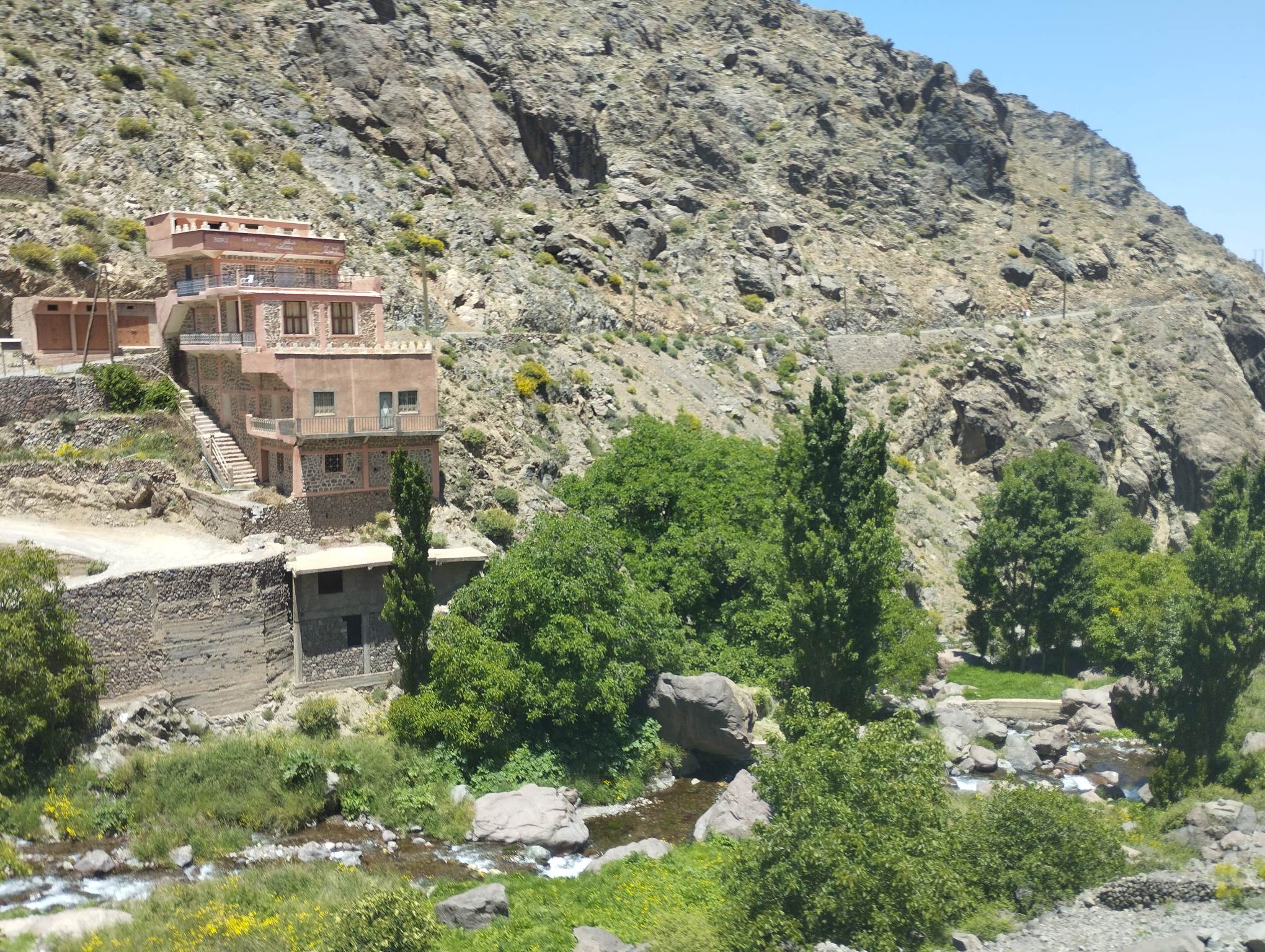
The pass itself is genuinely beautiful - wide valleys, terraced Berber villages clinging to hillsides, and a slow descent into increasingly arid scrubland as you approach the pre-Saharan south. You will see argan trees, roadside fossil and mineral sellers, and the landscape shifting from green Atlas valleys to ochre desert edges.
Be honest with yourself about the drive, though. The road is winding and demands concentration. If you or someone in your group is prone to motion sickness, stock up before you leave Marrakech. The switchbacks are numerous. Budget at least three and a half hours each way without stops, and closer to four and a half if you want to stop for photos or tea en route.
In winter (December to February), the pass can be icy or briefly closed after heavy snowfall. Check conditions if you are travelling outside the main tourist season. Spring and autumn are the most comfortable times to cross.
For a broader look at what the Atlas Mountains region has to offer, see our Atlas Mountains day trips guide.
Day Trip vs Part of the Sahara Route: The Honest Verdict
This is the question I get asked most often, and the honest answer is: a standalone day trip from Marrakech is marginal value.
Here is the maths. Leave Marrakech at 7am. Arrive Ait Ben Haddou around 11am. Explore for two hours, have lunch. Leave by 1:30pm to arrive back in Marrakech by 5:30pm, later if there are roadworks or the pass is busy. That is roughly eight hours in total, with two of them spent at the actual site.
The ksar itself can be explored thoroughly in 90 minutes to two hours. You can climb to the granary at the top, wander through the lanes, and cross the dry riverbed on foot. It is not a full-day site on its own. So the question becomes whether you find the High Atlas drive itself worthwhile as an experience, not just transit.
If you are on a Marrakech-only trip and the Sahara is not in your plans, the day trip is still worth doing - the Tizi n’Tichka drive is genuinely spectacular and the ksar is like nowhere else in Morocco. But go in knowing that most of your day is the journey, not the destination.
If you have four or more days and any interest in the desert, then the far better option is to include Ait Ben Haddou as an overnight stop on the Sahara route. You stay in a guesthouse on the village side of the riverbed, walk the ksar at sunrise before the tour buses arrive, continue to Ouarzazate the next morning, and then press on through the Draa Valley toward the dunes. That version of the trip is completely different in quality. See our Sahara desert tours guide for how the route is typically structured.
You can also see how Ait Ben Haddou fits into a longer trip on our Morocco itineraries page. And if you are weighing up whether the Sahara detour as a whole is worth the time, our piece on is a Morocco Sahara tour worth it goes into that in more detail.
Ouarzazate: Atlas Film Studios and Taourirt Kasbah
If you are visiting Ait Ben Haddou - whether on a day trip or the Sahara route - Ouarzazate is only 30 km further on and is worth a couple of hours.
Atlas Film Studios is the largest film studio complex in the world by surface area. Entry costs 80 MAD (roughly €8) per person, which includes a guided tour of around two and a half hours. You walk through enormous standing sets that have been used across dozens of productions - Egyptian temples, Roman cities, biblical landscapes. Some sets are clearly deteriorating and others are actively maintained for ongoing productions. It is part museum, part working studio, and genuinely interesting even if you are not a film obsessive. Just temper expectations: this is not a Hollywood theme park. It is a working facility that happens to allow visitors.
Taourirt Kasbah sits in the centre of Ouarzazate and was once the seat of the powerful Glaoui clan, who controlled the southern Atlas passes in the early 20th century. Entry to the courtyard is free. The interior rooms - partly restored by UNESCO - cost 30 MAD (around €3). It is a 30-minute visit but worthwhile for the architecture and the brief context it gives on how power worked in southern Morocco before independence.
Ouarzazate itself is a sprawling, dusty town that was largely built to service the film industry and military. Do not expect a charming medina. The atmosphere is functional rather than beautiful. Eat, see the studios or kasbah, and move on.
Costs and Practical Notes
Ait Ben Haddou entry: There is no official entrance fee to the ksar itself. You will likely encounter locals at the entrance claiming to charge a fee - these are not official. You may be offered an unofficial guide for a small amount, which is your call. The only legitimate paid access is if you enter one of the privately owned merchant houses.
Atlas Film Studios: 80 MAD per person (approximately €8 / £7), includes guide.
Taourirt Kasbah interior: 30 MAD (approximately €3).
Getting there: The most practical option for most visitors is a private guided tour or joining an organised day trip from Marrakech. Shared grand taxis run from Marrakech’s Bab Doukkala to Ouarzazate (around 80-100 MAD per seat) and from there you can take another taxi to Ait Ben Haddou. Public buses exist but add time and complication. If you want flexibility and your own pace, a private driver is the cleanest option.
Timing: Arrive at the ksar before 10am if at all possible. Tour groups typically arrive mid-morning and the lanes become congested. The light is also far better at that hour. If you are overnighting nearby, a sunrise walk is genuinely one of the best experiences in this part of Morocco.
Accommodation: There are a handful of guesthouses directly across the river from the ksar, most in the 300-600 MAD range per night for a double room. Breakfast is usually included. Sleeping here means you get the site at either end of the day, which changes it completely.
You can browse Sahara-route tours that include an overnight at Ait Ben Haddou via our tours.
Frequently Asked Questions
How far is Ait Ben Haddou from Marrakech?
Approximately 190 km, via the N9 road over the Tizi n’Tichka pass. Driving time is three and a half to four hours each way without significant stops. Budget closer to five hours if you want to stop at the pass or any of the Atlas villages en route.
Is there an entry fee for Ait Ben Haddou?
No official entry fee exists for the ksar itself. You may encounter locals claiming to charge one - this is not official. Some private merchant houses inside the village may charge a small amount to enter. The Atlas Film Studios in nearby Ouarzazate charge 80 MAD, and the Taourirt Kasbah interior costs 30 MAD.
Do I need a guide at Ait Ben Haddou?
You do not need one. The ksar is small enough to navigate independently, and there is no entry system requiring a guide. That said, a local guide for 60-100 MAD adds real context - the history of the caravan routes, which buildings were used in which films, and the difference between the inhabited lower sections and the abandoned upper fortifications. If you go independently, the UNESCO information boards do a decent job of orientation.
Is the Tizi n’Tichka pass safe to drive?
Yes, in good weather and daylight. The road is fully paved and does not require a 4x4. The switchbacks are significant so confidence on mountain roads helps. In winter, check conditions before you travel - the pass can close briefly after heavy snowfall. Most hire cars can handle it fine.
Should I do Ait Ben Haddou as a day trip or stay overnight?
If you have the time, stay overnight. The difference between arriving with a tour bus at 11am and walking the ksar at 7am in near-silence is hard to overstate. Guesthouses near the site are inexpensive, and overnighting allows you to continue south the next day rather than turning straight back. If Marrakech is your only base, a day trip is still worth doing - just go in clear-eyed about how much of the day is driving.
What else can I combine with Ait Ben Haddou?
Ouarzazate is 30 km south and adds two to three hours with the Atlas Film Studios and Taourirt Kasbah. Beyond that, the route continues through the Draa Valley - Agdz, Zagora, and eventually the Erg Chigaga dunes - making Ait Ben Haddou a natural first overnight stop on any Sahara circuit. See our Sahara desert tours guide for the full route breakdown.
Ready to Book?
Browse curated Morocco tours from verified operators, filtered by interest and budget.
Find Your Perfect Tour