Last updated: June 2026
Telouet Kasbah is one of the most atmospheric places I have visited in Morocco - collapsing, genuinely historic, and almost entirely off the tourist circuit. It is also a 21 km detour on a mountain road that is not kind to small hire cars. Here is an honest account of whether the effort is worth it and how to do it properly.
The Tizi n’Tichka pass on the N9 between Marrakech and Ouarzazate is one of the most driven roads in southern Morocco. Most people cross it on the way to Ait Ben Haddou or the Sahara and look straight ahead. A few kilometres south of the col, there is a turnoff onto an older road that threads down through the Ounila Valley. That is the road to Telouet. Most hire cars just keep going. This guide explains why you might want to stop.
The History: Power, Betrayal and a Palace Left to Crumble
The Kasbah of Telouet was built and expanded over several decades by the Glaoui clan, the most powerful Berber family in the High Atlas. Construction of the main palace complex began around 1860, with around 300 craftsmen brought in from Fes and across Morocco. At its peak, the Kasbah was an extraordinary thing: reception halls tiled floor to ceiling in zellij, carved plasterwork, painted cedarwood ceilings in the tradition of Moroccan palace architecture.
The Glaoui clan sat at a strategic crossroads - literally. Before the N9 was built in the 1930s, the Ounila Valley was the main route for trans-Saharan trade caravans moving between the desert and Marrakech. The family taxed everything that moved through it. That control of commerce made them fabulously wealthy and politically important.
Thami El Glaoui - known as the Pasha of Marrakech - was the last and most powerful head of the dynasty. He collaborated extensively with the French Protectorate, using his alliance with colonial authorities to extend his power across southern Morocco. In 1953, he went further: he actively conspired with the French to depose Sultan Mohammed V, who was subsequently exiled to Madagascar. Many Moroccans considered this an act of profound betrayal.
It did not end well for El Glaoui. When independence became inevitable, he publicly asked forgiveness and is said to have kissed the ground before the returning Sultan. He died in January 1956, just weeks after Morocco’s independence. Much of his wealth was confiscated by the state. The Kasbah was abandoned almost immediately and has been slowly crumbling ever since.
That history - collaboration, betrayal, hubris, abandonment - is part of what makes Telouet so loaded as a place. The palace was never finished and was never preserved. You are walking through the actual ruins, not a restoration.
Getting There: The Detour from the N9
Telouet sits at around 1,800 metres elevation in the village of the same name. The turnoff from the N9 comes roughly 6 km south of the Tizi n’Tichka summit, on the Ouarzazate side. Look for signs to Telouet / Ounila Valley - the road is the RP1506.
From the turnoff, the Kasbah is about 21 km on a road that is paved but narrow and winding. Allow 30 to 40 minutes each way from the N9.
The road is passable in a standard hire car in dry conditions but take it steadily. There are sharp corners and sections where the surface deteriorates. If you are travelling in winter or after heavy rain, check conditions locally - the High Atlas can get snow and some sections can become difficult.
A 4x4 is not strictly necessary for the Telouet-only route. It is recommended if you are continuing on the back road to Ait Ben Haddou through the Ounila Valley (more on that below).
From Marrakech directly to Telouet: Around 2.5 hours (130 km) via the N9 and RP1506.
From Ouarzazate: Around 1.5 hours (80 km) via the N9, turning off at the pass.
There is no public bus to Telouet. You need your own vehicle, a hire car or a day trip from Marrakech. If you are on an organised tour, most operators can add Telouet to a Marrakech-to-Ouarzazate or Sahara itinerary for a supplement - check our tours to see current options.
What You Actually See Inside
The entry fee is around 20 to 30 dirhams (roughly €2-3), collected by the guardian who runs the site. There is no ticket booth in the formal sense - you pay at the gate. The guardian typically does an informal tour of the accessible areas, which takes about 45 minutes to an hour. Tipping the guardian an additional 20-30 dirhams is expected and fair.
A local official guide is available in the village for around 100-150 dirhams. For most visitors the guardian’s tour is enough, but if you have a serious interest in the history, hiring a guide beforehand is worthwhile.
What you can access falls into two distinct zones. The heavily ruined outer sections are largely open to the sky - collapsed rooflines, bare mud-brick walls, the bones of what were once stables and storage rooms. These areas are atmospheric but give no sense of what the palace actually looked like at its height.
Then there are the reception halls. These are what people come for. Two main halls retain their original decoration: intricate zellige tilework in geometric patterns covering the lower walls, ornate carved plaster above, and painted and gilded cedarwood ceilings. The craftsmanship is extraordinary - comparable to anything in the Bahia Palace in Marrakech - which makes the contrast with the surrounding ruin all the more striking. Windows are broken, ceilings are starting to go, pigeons have taken over sections. Nobody is restoring this. It is declining in real time.
The upper terrace has good views over the valley and the village. If you are there mid-morning you will also see the Kasbah’s shadow moving across the hillside, which is better for photography than the midday flat light.
Note: the September 2023 earthquake that affected Morocco caused some additional damage to Telouet. The site is open as of mid-2026 but some areas that were accessible previously may be restricted. Ask the guardian on arrival.
Combining Telouet with Ait Ben Haddou via the Back Road
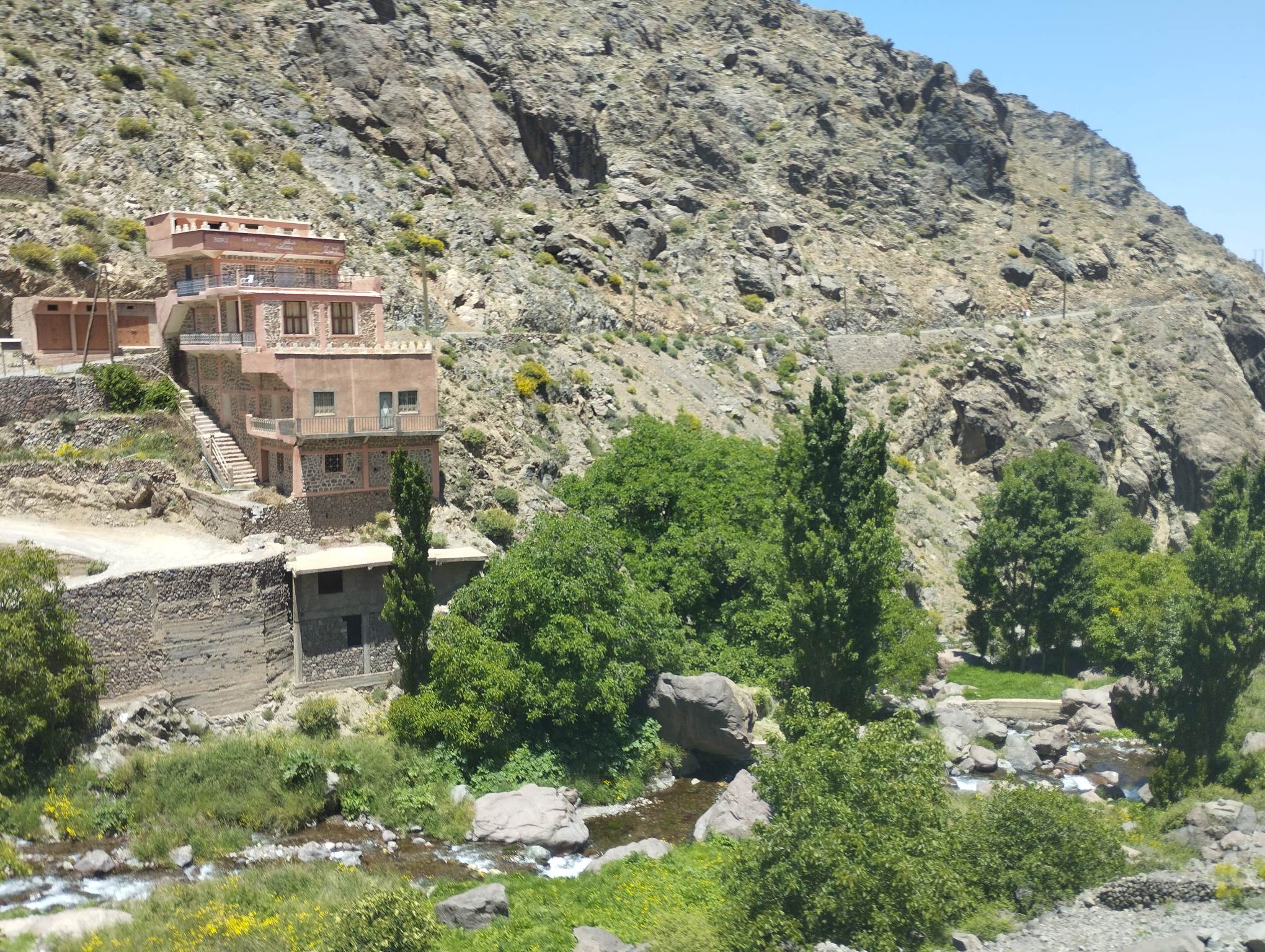
This is the reason most travellers end up at Telouet. The Ounila Valley road continues south from the Kasbah all the way to Ait Ben Haddou - roughly 70 km on an unsurfaced mountain track. This is the old caravan route, the road that Telouet controlled before the N9 made it redundant.
The back road is a serious drive. It requires a 4x4, takes around two to two and a half hours in good conditions and should not be attempted if it has recently rained heavily. Parts of the route cross the Ounila riverbed, which can run with water. Google Maps will give you a time estimate that is too optimistic.
The route passes through several worthwhile stops:
Anmiter - a well-preserved ksar in the middle of the valley with green terraced fields around it. Worth stopping for 20 minutes. This is what Ait Ben Haddou would look like without the visitors.
Tamdaght Kasbah - another Glaoui stronghold, smaller than Telouet, visible from the road. You can stop briefly; it is in private ownership.
Ait Ben Haddou - the route arrives at the back of the village, which means you enter without going through the tourist strip first. For first-time visitors, the ksar itself needs a couple of hours. See our full guide at /blog/ait-ben-haddou-guide.
Done together as a through-route - Marrakech to Telouet on the N9, then down the valley to Ait Ben Haddou and on to Ouarzazate - this works well as a full day with an early start. Leave Marrakech by 7am. You will not make it back to Marrakech the same day without serious rush, so this route makes most sense if you are heading to Ouarzazate or continuing south towards the Sahara.
If you are doing the Marrakech to Merzouga tour route, adding Telouet adds roughly three hours to your day and is best combined with an early start and a night in Ouarzazate rather than rushing through.
See /guides/morocco-itineraries if you are still working out how Telouet fits into a larger trip. For a broader overview of what the Atlas offers on day trips, /guides/atlas-mountains-day-trips covers the full range from Marrakech.
Photography at Telouet
The zellige halls photograph beautifully but light conditions matter. The interior rooms have small windows and relatively low light - bring a camera that handles low light well, or be prepared for slow shutter speeds. A tripod is useful and the guardian will not object.
Mid-morning (9-11am) is the best time for the exterior and valley views. Midday light is flat and harsh. If you have any control over your arrival time, aim for 9am.
The contrast between the ornate interior decoration and the visible decay is the most striking visual at Telouet. Get close to the tilework. The detail is extraordinary and it photographs better at a few feet than wide-angle.
Drones require a permit in Morocco and enforcement is variable, but the Kasbah itself is a culturally sensitive site with local residents around. I would not fly one here without clearing it with the guardian first.
Costs Summary
- Entry fee: 20-30 MAD per person (approximately €2-3)
- Guardian tip: 20-30 MAD (consider this part of the entry cost)
- Local guide (optional): 100-150 MAD
- Fuel from Marrakech return: approximately 200-250 MAD depending on car
- Hire car day rate: varies, budget 350-500 MAD for a basic manual
If you book a day tour from Marrakech that includes Telouet and Ait Ben Haddou, prices typically run from around 600-900 MAD per person in a shared group, or 1,500-2,500 MAD for a private driver. Check /tours/ for current Explora Morocco itineraries that include the Ounila Valley route.
The Honest Verdict: Is Telouet Worth It?
Yes, with caveats.
If you are already driving the N9 between Marrakech and Ouarzazate, the detour is absolutely worth the extra hour and a half. The decorated halls are genuinely spectacular, the history is fascinating and dark, and the site has an atmosphere that polished tourist destinations rarely have. The ruination is part of it.
If you have a 4x4 and are heading to Ait Ben Haddou anyway, the back road through the Ounila Valley is one of the better drives in Morocco. Slow, rough, but beautiful and quiet.
If you are on a tight one-day Marrakech round trip with no intention of continuing south: it is harder to justify. You are adding 42 km of mountain driving and at least 90 minutes to a day that already involves 7+ hours of driving. It tips an already long day into something exhausting.
The people who love Telouet most tend to be those who slow down in Morocco rather than ticking boxes. If that is you, it belongs on your list.
Frequently Asked Questions
How much does it cost to enter Telouet Kasbah?
Entry is approximately 20 to 30 Moroccan dirhams (around €2-3) paid to the guardian at the gate. There is no formal ticket office. Add another 20-30 MAD as a tip for the guardian, who provides an informal guided tour of the accessible areas. A local guide from the village costs around 100-150 MAD if you want more historical depth.
How far is Telouet from Marrakech?
Telouet is approximately 130 km from Marrakech - around 2.5 hours driving via the N9 and the RP1506 turnoff. The detour from the N9 adds 21 km each way on a narrower mountain road.
Do I need a 4x4 to visit Telouet?
Not for Telouet alone. The RP1506 from the N9 is paved and passable in a standard hire car in dry conditions. If you plan to continue from Telouet through the Ounila Valley to Ait Ben Haddou on the back road, you do need a 4x4. That section is unpaved mountain track with riverbed crossings.
Can I visit Telouet as a day trip from Marrakech?
You can, but it is a long day. Telouet alone as a return trip from Marrakech gives you around two to three hours at the site if you leave early. The more common approach is to combine it with Ait Ben Haddou via either the N9 (both sites as stops on the main road circuit) or the back road (4x4 only), staying overnight in Ouarzazate rather than returning to Marrakech.
Is Telouet Kasbah open after the 2023 earthquake?
As of mid-2026, yes. The September 2023 earthquake caused some additional damage and the site was temporarily closed for assessment. It has since reopened. Some previously accessible areas may now be restricted - confirm with the guardian on arrival before assuming full access.
What is the best time of year to visit Telouet?
Spring (March to May) and autumn (September to November) give the best driving and walking conditions. Summer is hot in the valley and the road from Marrakech gets busy with tourist traffic. Winter is possible but snow can close the Tizi n’Tichka pass temporarily, and the back road to Ait Ben Haddou becomes much riskier after rain. Always check pass conditions before driving in December through February.
Ready to Book?
Browse curated Morocco tours from verified operators, filtered by interest and budget.
Find Your Perfect Tour