Where you are
A quiet coastal town and a working medina ask different things of you. The place sets the rhythm before any advice does.
Every Morocco tourist scam explained with the exact scripts used and word-for-word responses. Fake guides, henna grabs, spice tours, and overcharging.
Morocco receives nearly 20 million tourists a year.
02Where it happens: Jemaa el-Fnaa and the entrances to the Marrakech medina.
03Where it happens: Jemaa el-Fnaa square, the main medina entrance areas, and popular photo spots near the tanneries.
Last updated: March 2026
This is not a page of vague warnings. It is a forensic breakdown of exactly what happens, what they say, and what you say back.
This is not a slur on Morocco or Moroccan people.
Morocco receives nearly 20 million tourists a year. A significant portion arrive with limited local knowledge, don’t speak Arabic or French, and are visibly wealthy by local standards. The income gap between the average Moroccan and the average European tourist is enormous. That economic reality has produced a persistent hustler culture, particularly around the major medinas, that treats tourists as a revenue opportunity.
This is not a slur on Morocco or Moroccan people. The overwhelming majority of people you will interact with are not trying to scam you. The people who are trying to scam you are a small, concentrated group who operate in specific places using specific scripts. Knowing those scripts removes their power entirely.
Where it happens: Jemaa el-Fnaa and the entrances to the Marrakech medina. The Fes medina gate area. Major tourist sites across Morocco.
How it starts: A friendly person approaches you and says “the main entrance is this way” or “you can’t go that way, the souk is closed” or simply starts walking alongside you making conversation. He might say he’s a student who wants to practise his English.
The script, almost verbatim:
He will not accept a polite “no.” He has spent time with you and now believes you owe him. The “suggested” payment is typically 200-500 MAD but can go higher with pressure.
What to do:
Where it happens: Jemaa el-Fnaa square, the main medina entrance areas, and popular photo spots near the tanneries.
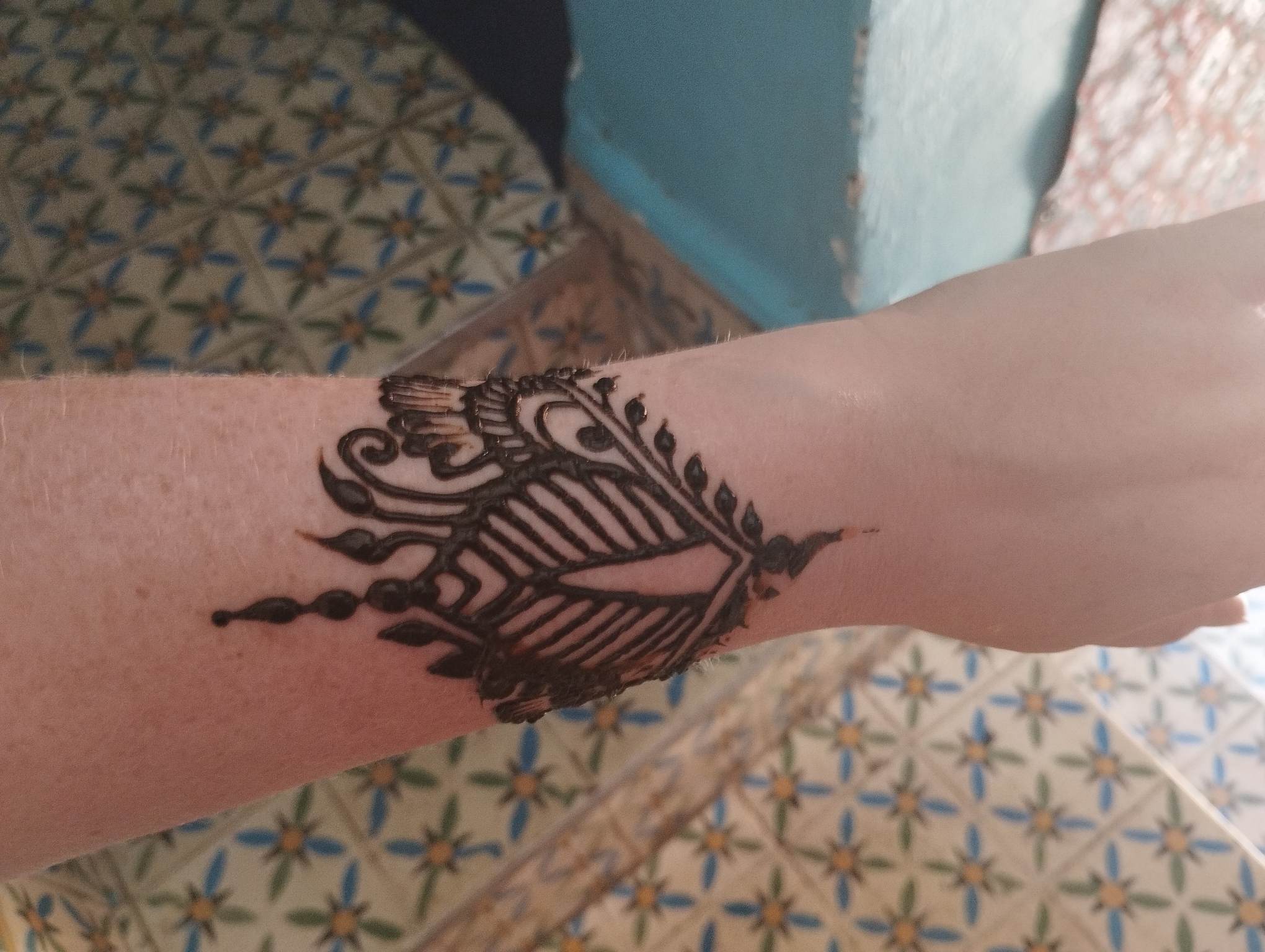
What happens: A woman (often with other women nearby) approaches and starts applying henna to your hand without asking. Once it’s on, she demands payment. Quoted prices range from 200-600 MAD, sometimes more. The demand is accompanied by emotional pressure: “I have children, this is how I feed them.”
One traveller’s account, verbatim: “A henna vendor grabbed my arm and wouldn’t let go, demanding €60 for henna I had repeatedly declined.”
What to do:
The script: The destination is invariably a shop: spice shop, argan oil cooperative, carpet shop, leather good store.
Where it happens: Throughout Marrakech and Fes medinas, near the entrance to the souks.
The script:
The destination is invariably a shop: spice shop, argan oil cooperative, carpet shop, leather good store. Once inside, the pressure to buy begins. The products are often dramatically overpriced (10-20x the souk rate). Leaving without buying involves pushing through social pressure and sometimes blocking.
What to do:
Where it happens: Throughout the souks, street food stalls, taxis.
This is not always a deliberate scam in the sense of deception. It is simply dual pricing: local price and tourist price. The tourist price for most items in the souks is 3-10x the local price. This is standard practice and expected from both sides.
How to handle it:
See our full bargaining guide for the complete approach.
Jemaa el-Fnaa, Marrakech’s main square, is a UNESCO world heritage site, a spectacular place to spend an evening, and a concentration point for almost every scam on this list.
Specific things to be aware of:
Tipping is expected throughout Morocco.
Tipping is expected throughout Morocco. Here are the amounts that are standard and not exploitative:
Morocco’s scam culture is predictable. Once you know the scripts, they lose their power. You will recognise the fake guide’s opening line. You will move your hand before the henna artist grabs it. You will say “la shukran” and keep walking.
None of this needs to overshadow the trip. Most of your interactions in Morocco will not involve scams at all. The spice seller who gives you a genuine price, the medina resident who corrects your directions because you’re lost, the riad owner who recommends a restaurant they genuinely like: these interactions are the majority.
Know the tactics. Deal with them efficiently. Get on with the trip.
Next: Morocco Safety Guide | Solo Female Travel Morocco | Morocco Itineraries
A quiet coastal town and a working medina ask different things of you. The place sets the rhythm before any advice does.
Season, daylight and how busy a route is will move the answer more than most checklists admit.
Pace, company and how much you have travelled before matter more than a list of rules.
A short guided orientation can remove a lot of guesswork on a first visit, especially in a city you are trying to read on foot. It is a low-effort way to settle in.
Explora Morocco does not run tours. What follows is a partner listing, so check the pace, route and what is named on the page itself before booking.
See suitable toursParent pillar: Morocco first-trip guide
Conditions, rules and local realities change. Before you travel, verify entry information, current advice and anything practical this guide describes. A guide stays useful only while its information is current.
Almost every visitor has a scam attempt directed at them. Most learn to deal with it after the first day. The difference between an attempt and a successful scam is preparation. You now have the preparation.
No. “La shukran” (no thank you) is a complete sentence in Morocco as anywhere. The guilt framing (“I have children,” “you are in my country, you should be respectful”) is part of the pressure tactic. It does not mean you owe anything.
It happens. Pay it, move on. The money is not worth the stress of a confrontation. Consider it the expensive version of the lesson you won’t repeat. The first day in Marrakech has a tuition cost for most people.
Absolutely. The souks are brilliant. Leather goods, ceramics, spices, textiles, and argan products are genuinely good quality and available at reasonable prices if you negotiate. Just negotiate.
Generally yes. The pace is slower, the crowds are smaller, and the hustle culture is less intense. Some touts operate there but the experience is materially different. See Chefchaouen tourist traps.