Atlas Mountains day trips from Marrakech: honest prices, drive times, Toubkal trek, Ourika, Ouzoud, Agafay, Ait Ben Haddou, and which are worth it.
Last updated: June 2026
The High Atlas is 45 minutes from Jemaa el-Fnaa, and most people have no idea. You can be standing in a Berber village, breathing mountain air, watching mule trains on a stone path, while the city is still close enough to return for dinner. But some of these day trips are excellent and some are long, expensive rides to tourist stalls. This guide tells you which is which.
How the Atlas Mountains Work as Day Trips
The High Atlas range runs southwest to northeast directly above Marrakech. Several valleys cut into it from the city side, which is why so many day trips are genuinely viable - you don’t need to cross the whole range to get to beautiful mountain terrain.
The key factor is what you want from the day. Scenery? Hiking? A specific landmark? Understanding your goal matters because the options are quite different from each other. Ourika gives you a valley and a waterfall. Imlil gives you a mountain village and access to Toubkal. Ait Ben Haddou is really a film-set kasbah in the pre-Saharan plains rather than the mountains proper. Agafay is a stone plateau, not mountains at all.
For most of these, you have two options: book an organised tour or go independently by grand taxi. The honest version of that comparison is below. First, the destinations.
Ourika Valley - Worth It, But Go With a Plan
Drive from Marrakech: 1 hour to 1 hour 20 minutes (65 km)
Organised group tour price: from €16-25 per person
Private tour: from €90 for 1-4 people
Grand taxi: around 60-80 MAD per seat each way
The Ourika Valley is the easiest mountain day trip from Marrakech - a green river valley running up into the Atlas, with Berber villages on the terraced slopes, walnut groves, and a waterfall at the top called Setti Fatma. On paper it sounds lovely. In practice it can be either genuinely lovely or a coach-park in a gorge, depending on how you do it.
The tourist-trap version of Ourika goes like this: you join a large group tour, stop at an argan oil cooperative on the way (a commercial partner of most tour operators, not a spontaneous cultural detour), arrive at the main valley floor car park around midday when it’s crowded, walk to the waterfall, eat lunch at a riverside restaurant, and drive back. Fine, but not memorable.
The better version leaves early - before 8am if possible. The valley is genuinely quiet in the morning. The hike to the Setti Fatma waterfalls is short but involves scrambling over rocks and slippery boulders near the top - it is not a gentle stroll, despite what many tour listings imply. Anyone with knee problems or poor balance should know this in advance.
The valley villages themselves, particularly the smaller ones further up the road before Setti Fatma, give you a much better sense of actual mountain Berber life than the crowded waterfall area. If you have your own transport or hire a grand taxi by the day, you can stop at these rather than just the designated tourist points.
What makes Ourika worth it: it’s genuinely beautiful, it’s close, and a well-run early tour gives you cool air, empty paths and views that feel miles away from the Marrakech medina. Browse day trips from Marrakech on our tours page to compare the Ourika options - some operators do early departures and smaller groups.
Imlil and Mount Toubkal - The Serious Atlas Option
Drive from Marrakech: 1 hour 10 minutes to Imlil (63 km)
Grand taxi Marrakech to Imlil: 50 MAD per seat (about €5), or 300 MAD to hire the whole taxi
Organised Toubkal 2-day trek: from €120-280 per person depending on group size
Day hike from Imlil: free to walk independently (guide mandatory for summit)
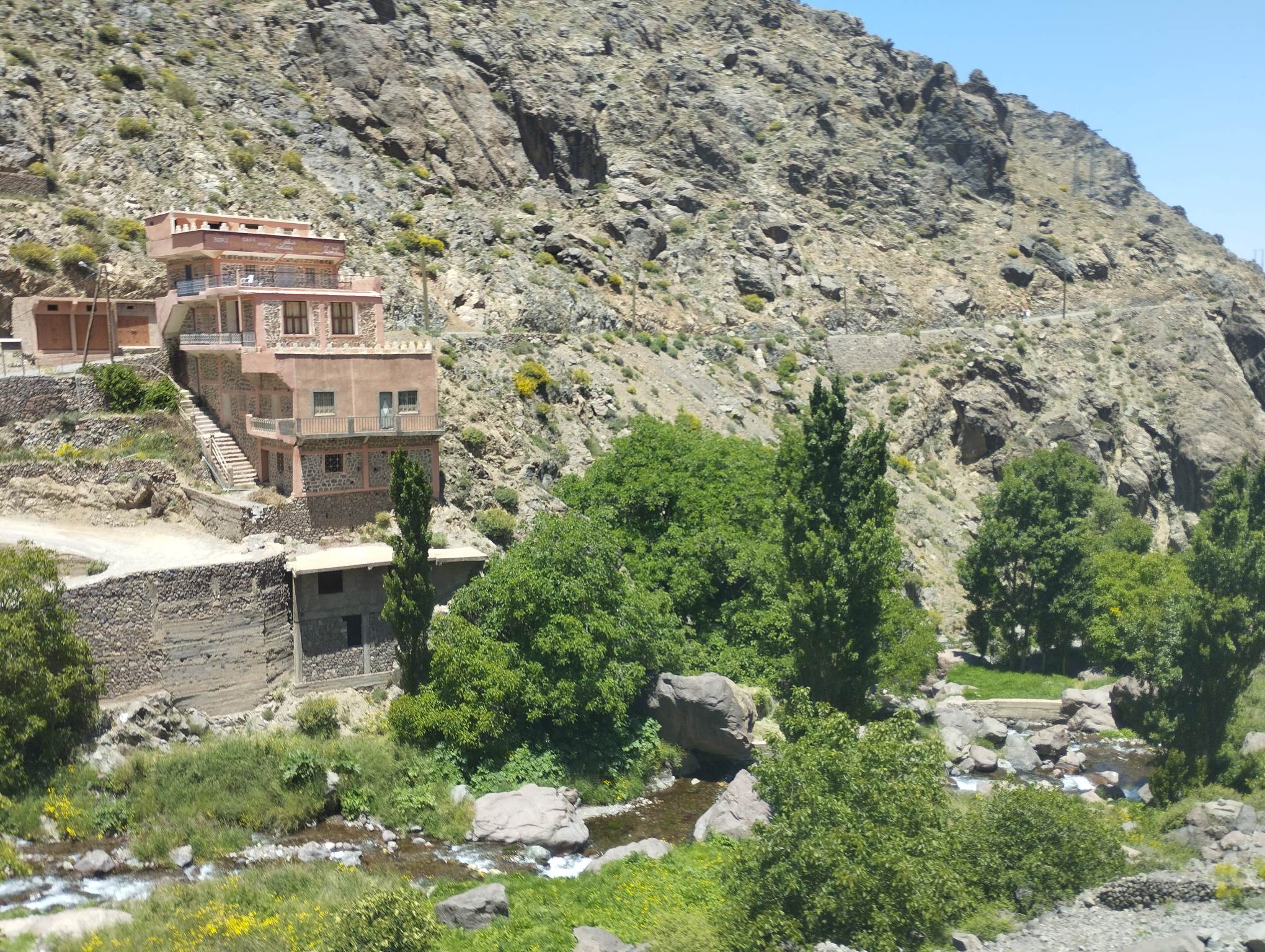
Imlil sits at 1,740m and is the base village for trekking in this part of the Atlas. It is a genuine mountain village, not a tourist-facing settlement, and even arriving there without any trekking plans feels worthwhile - the main street has a few small guesthouses, a bakery, mule traffic, and views up to the peaks that are simply stunning on a clear day.
Mount Toubkal itself stands at 4,167m - the highest peak in North Africa and the Arab world. Reaching the summit is the ambition of a lot of visitors, and it is achievable without technical climbing experience for most of the year, but it requires more than a day trip from Marrakech.
The realistic schedule is:
- Day 1: Drive from Marrakech to Imlil, trek 5-7 hours to Refuge du Toubkal at 3,207m, overnight in the refuge (basic bunk accommodation, meals available)
- Day 2: Summit push (4 hours up, 2.5-3 hours down), return to Imlil, drive back to Marrakech
A licensed guide has been legally required for the summit since 2018. They register you at the police checkpoint in Imlil and handle any mountain rescue coordination. For a 2-day guided ascent, budget around €100-130 per person including guide, transport, meals and refuge accommodation (guide fees alone run around 400 MAD/€40 per day).
November to February requires crampons and an ice axe. Do not attempt the summit in winter without proper kit and an experienced guide. April to October is the standard season with the best conditions from May to September.
If you only have one day and want a flavour of the area without committing to the trek, Imlil village itself plus a walk up the valley toward the Aroumd village (about 2-3 hours round trip) is a genuinely good day. You get the Atlas landscape, village life, and altitude without a full overnight commitment. You can reach Imlil independently for around 50 MAD each way per seat in a grand taxi from Bab Rob in Marrakech.
See our Sahara desert tours guide if you’re planning to combine mountain time with a desert route - the two work well together as part of a longer Morocco trip.
Ouzoud Waterfalls - The Best Pure Scenery Day Trip
Drive from Marrakech: 2 to 2.5 hours each way (160 km northeast)
Organised group tour: from €19-30 per person
Private tour: from €120
Full day: expect 9-10 hours door to door
The Ouzoud Waterfalls are Morocco’s tallest at 110 metres, and they are genuinely spectacular. Three channels of water drop over terracotta cliffs into a turquoise pool below, with resident Barbary macaques in the surrounding trees and a small Berber village above. Optional boat rides on the pool below the falls cost about 30-40 MAD.
This is probably the single best day trip from Marrakech in terms of visual payoff. The falls are most impressive in spring (March to May) when the water volume is highest after winter rains. By August the flow reduces significantly.
The drive northeast takes you through the Middle Atlas foothills rather than the High Atlas, so the landscape is different from Imlil or Ourika - rolling hills and Barbary cedar forest rather than dramatic peaks. That journey is itself pleasant.
The honest catch: it’s a long day. Two and a half hours each way is tiring even on good roads, and you spend most of the day in a vehicle. It’s absolutely worth it, but go in knowing you’ll be back late and tired. Bring snacks, a hat, and good shoes for the path down to the pool which involves steps cut into the cliff.
Independent travel to Ouzoud is possible but awkward - public buses go as far as Azilal (2-3 hours) and then it’s a petit taxi or local transport the remaining 24km. An organised day trip from Marrakech is genuinely the easier call here. Check the tours page for current Ouzoud options - smaller group sizes make the day feel less like a convoy.
Ait Ben Haddou and Ouarzazate - Not Really a Day Trip
Drive from Marrakech: 3 to 4 hours each way over the Tizi n’Tichka pass (180 km)
Group tour: from €23 per person (long days)
Private 2-day tour: from €530 for two people
Recommended minimum: 2 days
Let’s be direct about this one: Ait Ben Haddou is 180km from Marrakech over the Tizi n’Tichka mountain pass, which involves switchback bends at 2,260m altitude. The drive takes 3.5-4 hours minimum each way in good conditions. Doing this as a single day trip means roughly 7-8 hours of driving for 2-3 hours at the site. Many tour operators offer this as a day trip. Most travellers who do it describe the day as exhausting.
Ait Ben Haddou itself is extraordinary - a UNESCO World Heritage ksar (fortified village) built from rammed earth and decorated with geometric patterns, rising in terraces above the Ounila River. You’ve seen it in films without knowing: Game of Thrones (Yunkai), Gladiator, Lawrence of Arabia, and dozens of others were filmed here. There are families who still live in the lower section, though most residents have moved to the newer village across the river.
Crossing the river to enter the ksar costs nothing, but a local guide (available at the entrance, around 50-100 MAD) makes the site far richer - they know which buildings were used for which productions and can take you to the top grain store for the best view.
Ouarzazate, 30 minutes further, has the Atlas Film Studios (the largest in Africa, genuinely worth seeing, entrance around 80-100 MAD) and the Taourirt Kasbah in the town centre.
My honest recommendation: make this part of a multi-day itinerary rather than a rush-back day trip. Spend a night in Ouarzazate, continue to the Draa Valley and then the Sahara from there. This is the natural gateway to the south, and it works beautifully as part of the 3-day Sahara route described in our Sahara desert tours guide. Check Morocco itineraries for how to slot this into a 7 or 10-day trip.
If you can only do one day, go by organised tour - the Tizi n’Tichka is not a road to self-drive while you’re tired - and accept that you’ll see the highlights at pace.
Agafay Desert - Honest Assessment
Drive from Marrakech: 35-45 minutes (30 km)
Day trip with activities: from €25-70 per person
Overnight camp: from €60 budget to €400+ luxury per night
What it actually is: a stone plateau, not a sand desert
The Agafay is marketed as a “desert” experience near Marrakech, and in terms of landscape - vast, open, dry, sparse vegetation - the word applies loosely. But you need to know what it is and isn’t before you go.
What it is: a hammada, or stone/pebble plateau, south of Marrakech. The soil is pale, the horizon is wide, and the Atlas Mountains form a dramatic backdrop to the north. At sunset the light is beautiful. There are luxury camps, some with pools, that provide a genuinely comfortable glamping experience. For a Moroccan dinner under canvas with that Atlas backdrop, it works.
What it isn’t: the Sahara. There are no golden sand dunes. No sea of erg stretching to the horizon. No Erg Chebbi, no Erg Chigaga, none of the classic desert imagery. If you’ve seen photos of camel trains crossing orange dunes and you’re expecting that, you will be disappointed.
Who it works for: people with limited time (it’s 40 minutes from the city, not 8+ hours like the real Sahara), families with young children, travellers who want an evening experience rather than a full-day commitment, or anyone who wants a night under stars without the travel.
Who should push for the real Sahara instead: anyone with 3+ days available. The Sahara is transformative in a way Agafay is not. See our guide to Morocco Sahara tours and the blog post on whether a Sahara tour is worth it to help decide.
Day trip packages typically include transport, camel or quad ride, sunset viewing, and a traditional dinner - roughly 250-700 MAD (€25-70) per person. Overnight luxury camps range from €120 to €400 per person including dinner and breakfast. For the best time to visit the Sahara, the same seasonal logic applies here: October to April for cooler temperatures, May to September for heat.
Asni and the Kik Plateau - The Off-the-Radar Option
Drive from Marrakech: 50 minutes to Asni (47 km on the N9)
Grand taxi from Bab Rob: around 15-20 MAD per seat
If you’ve been to Imlil and want something quieter, or if you want to see the Atlas landscape without committing to a trek, the Kik Plateau above Asni is an underused option. The plateau sits at around 1,800-2,000m and offers wide-open walking with Atlas views and very few other visitors.
Asni itself is a market town - the Saturday souk here is one of the more authentic in the Atlas region, drawing Berber traders from the surrounding villages rather than tourists. Going on a Saturday and then walking up towards the plateau makes for an excellent combined day.
There’s no famous landmark here and no structured tour. That’s the point.
Berber Village Visits - What’s Real and What’s Staged
Most Atlas day trips include a “Berber village” stop, and these vary enormously in authenticity. The villages along the main Ourika Valley road are well used to tour groups. The better experiences come from the smaller side-valley settlements you only reach on foot or with a guide who knows them.
Genuine Berber hospitality - tea in a family home, lunch prepared with produce from the terraced fields, a conversation about the seasonal migration between altitude grazing areas - does exist and is available through guides who live in these communities rather than commuters from Marrakech.
When booking, ask specifically where the village stop is and whether your guide is local to that valley. A guide from Imlil or the Ourika Valley itself knows people and places that a city-based operator doesn’t.
The tours page includes options with locally-based guides where available.
Organised Tours vs Going Independent
This is worth addressing directly because the calculus is different for each destination.
Go independent (grand taxi) when:
- You’re going to Imlil - it’s straightforward, the taxi stand near Bab Rob sends taxis there regularly, and 50 MAD per seat is a fraction of any tour price
- You’re going to Ourika early in the morning and want to set your own pace through the valley
- You have experience with Moroccan transport and aren’t anxious about the logistics
Book an organised tour when:
- You’re going to Ouzoud - the journey is long and a tour handles all logistics for a reasonable price
- You’re going to Ait Ben Haddou - the Tizi n’Tichka pass is not a road to self-drive tired, and a guide adds real value at the site
- You want a specific activity (Toubkal summit, camel in Agafay) where a guide or operator is part of what you’re paying for
- You have limited time and don’t want to spend any of it figuring out taxi stands
For the Toubkal summit, an organised trek through a licensed operator is genuinely the better option regardless of budget. The guide requirement is legal, the logistics (refuge booking, transport, food) are handled, and having someone who knows the mountain with you is simply safer.
Browse the Explora Morocco tours page to compare current options across all these destinations.
What to Skip or Combine
Day trip from Marrakech to Ait Ben Haddou: Do it as an overnight or as part of a multi-day south route. The day trip version exists but is punishing.
Standalone Agafay evening trip: Fine, but if you’re going anyway, combine it with a morning in the Kik Plateau area rather than making the Agafay camp your whole day.
Ourika Valley in July or August on a weekend: The road gets badly congested and the valley floor is crowded. Go on a weekday and leave early.
Any Atlas “camel ride” that’s under 30 minutes: Not worth it. A brief camel walk in a car park is not what you came to Morocco for. The real camel experience is in the Sahara - read whether a Sahara tour is worth it before deciding.
Planning These into a Larger Morocco Trip
The Atlas day trips work best when they’re planned alongside your time in Marrakech and any longer routes south. A rough priority order based on six trips:
- Imlil or Ourika - pick one, do it early in your Marrakech stay while your energy is high
- Ouzoud - any day, full commitment needed, worth it
- Ait Ben Haddou/Ouarzazate - only if you’re routing south to the Sahara anyway
- Agafay - a pleasant evening option if you have a spare night
For help threading these into a full itinerary, see Morocco itineraries and the Marrakech travel guide. If the Sahara is calling, start with our Sahara tours guide.
Frequently Asked Questions
How long is the drive from Marrakech to the Atlas Mountains?
It depends where you’re going. Imlil and the Ourika Valley are both around 60-65km from Marrakech - roughly 60 to 90 minutes driving. The Ouzoud Waterfalls are 160km northeast (2 to 2.5 hours). Ait Ben Haddou is 180km over the Tizi n’Tichka pass and takes 3.5 to 4 hours. The Agafay plateau is the closest - just 30km south, under 45 minutes.
Do you need a guide to climb Mount Toubkal?
Yes. Morocco made it legally mandatory in 2018 for all trekkers heading to the Toubkal summit to use a licensed mountain guide. Your guide registers you at the police checkpoint in Imlil. Beyond the legal requirement, having a guide on a 4,167m mountain is simply the sensible choice - conditions can change fast. Budget around 400 MAD (roughly €40) per day for a licensed guide, or book an all-inclusive 2-day trek from around €120-130 per person.
Is Agafay the same as the Sahara Desert?
No. Agafay is a stone and pebble plateau (a hammada) about 30km south of Marrakech. It has open, arid landscape and the Atlas as a backdrop, but there are no sand dunes. The real Sahara - Erg Chebbi at Merzouga or Erg Chigaga near M’Hamid - is 8-10 hours from Marrakech by road. If you want golden dunes, plan for the Sahara route. If you want a scenic desert-flavoured evening near Marrakech, Agafay delivers that.
Can you visit Ait Ben Haddou as a day trip from Marrakech?
You can, but it’s a tough day - 3.5 to 4 hours each way over a mountain pass means 7-8 hours of driving for around 2-3 hours at the site. Operators run day trips from around €23 per person, and they exist because there’s demand. A better option is to spend one night in Ouarzazate or near Ait Ben Haddou itself, which lets you see the ksar at golden hour without rushing, and then continue south toward the Sahara the following day.
What is the best time of year for Atlas Mountains day trips?
March to May and September to November are the ideal windows. Spring brings green valleys, wildflowers in the Ourika, and the waterfalls at Ouzoud and Setti Fatma at full flow. Autumn is clear and warm without summer heat. July and August are hot in the valleys and the Ourika road gets congested at weekends. For Toubkal specifically, snow can remain on the summit until June and returns by November - crampons are needed from December through March.
How do I get to Imlil independently without a tour?
Grand taxis to Imlil leave from the taxi stand near Bab Rob (Bab Agnaou) in the Marrakech medina. Walk up to the drivers and say “Imlil” - you’ll be directed to the right vehicle. Seats cost around 50 MAD each way (about €5). The taxi fills with other passengers going the same direction; you can pay for all six seats if you want to leave immediately rather than wait. The journey takes about 70 minutes on a winding mountain road.
Are Berber village visits in the Atlas authentic?
Genuinely mixed. Villages along the main Ourika road see many tour groups and have adapted to that. Smaller settlements reached on foot or via local guides are significantly more genuine - you’re more likely to be invited into a home, share a meal, and meet people going about their actual lives rather than a staged welcome. The quality of your guide matters enormously. Ask whether they’re from the valley you’re visiting, not based in Marrakech.
Ready to Book?
Browse curated Morocco tours from verified operators, filtered by interest and budget.
Find Your Perfect Tour